
Business
How UK Businesses With Offshore Interests Can Stay HMRC Compliant

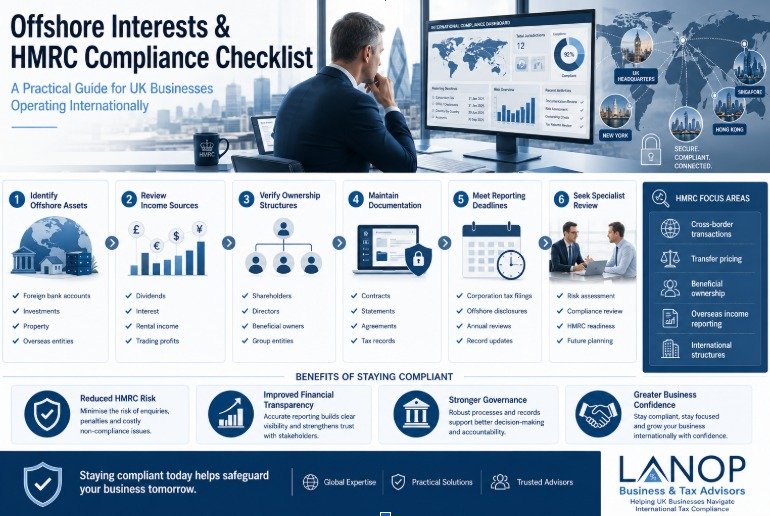
Running a business with international interests creates a particular kind of compliance pressure that purely domestic operations never encounter. Foreign income streams, overseas subsidiaries, offshore bank accounts, and international property holdings all generate reporting obligations that many business owners either underestimate or discover too late. Most turn to offshore accountants UK firms trust precisely at the point where complexity has outpaced internal capability often after a gap has already opened in the reporting record. This guide explains what HMRC expects from businesses with offshore interests, where compliance most commonly breaks down, and how to build the kind of systematic approach that keeps international operations on the right side of the rules.
Why Offshore Compliance Matters More Than Ever?
The landscape changed significantly with the introduction of the Common Reporting Standard. Before CRS, a business or individual could hold offshore accounts with a reasonable expectation that overseas institutions would not automatically share information with UK authorities. That assumption no longer holds. Over 100 countries now participate in automatic information exchange, and HMRC receives data on foreign bank accounts, investment holdings, offshore company ownership, and overseas property interests as a matter of routine.
The practical consequence is simple: offshore activity that was previously difficult for HMRC to detect is now visible through channels that operate independently of anything a UK taxpayer chooses to disclose. A foreign bank reports account balances and interest to its local tax authority, which shares that data with HMRC under the CRS framework. The information arrives regardless of whether the account holder has included it on a UK tax return.
This is not a theoretical risk. HMRC actively cross-references CRS data against submitted returns and investigates discrepancies. A business that has been operating internationally for several years without proper offshore reporting is not simply behind on paperwork.it has a compliance exposure that compounds with each year that passes.
What HMRC Considers an Offshore Interest?
The scope is broader than most business owners initially assume. Offshore interests subject to UK reporting include overseas subsidiaries and branch operations, foreign bank accounts held in the business name or personally by directors, overseas investment portfolios, international property holdings generating rental income or capital gains, offshore trust structures where the business or its directors hold beneficial interests, foreign dividends, royalties, and licensing income, and income derived from international contracts or partnerships.
The thread connecting all of these is UK tax residency. If the beneficial owner, the individual or company that actually controls or profits from the offshore arrangement is a UK tax resident, reporting obligations to HMRC follow that residency regardless of where the income arises or the asset sits.
The Compliance Risks Most Businesses Underestimate
The errors that create the most significant HMRC exposure are rarely deliberate. They are almost always the product of misunderstanding what needs to be reported, not of attempting to hide anything.
Assuming overseas income is not taxable in the UK is the most common. A UK company with a subsidiary in Dubai may assume that profits generated in the UAE, where corporate tax applies differently, are outside HMRC’s reach. Under the Controlled Foreign Company rules, this assumption is frequently wrong. UK-resident owners of overseas companies can face UK tax charges on certain offshore profits regardless of whether those profits are repatriated.
Poor record keeping across borders creates a different kind of problem. Transactions between a UK parent and an overseas subsidiary need to be documented at arm’s length under transfer pricing rules. Informal arrangements intercompany loans without interest, management fee arrangements without documentation, expenses recharged without clear basis attract HMRC attention and can be very difficult to defend retrospectively without contemporaneous records.
Rapid international expansion consistently creates compliance gaps. A business that opens an overseas office, starts employing contractors in another jurisdiction, or enters into international licensing arrangements often does so at pace, with compliance treated as something to formalise later. Later often arrives as an HMRC enquiry.
Offshore Income UK Businesses Most Commonly Forget to Report
Foreign Dividends
Dividends received from overseas company holdings are reportable in the UK, subject to the dividend allowance and relevant reliefs. Many business owners treat overseas dividends differently from domestic ones without any legal basis for doing so.
Overseas Rental Income
Property held overseas and generating rental income creates a UK reporting obligation. The income needs to be converted to sterling, allowable expenses can be deducted, and the net figure reported on the relevant return. Inherited overseas property that subsequently generates rental income is a particularly common gap; people receive the asset, begin receiving rental payments, and never connect the two to a UK reporting requirement.
Foreign Interest Income
Business accounts held overseas, whether for operational convenience in an international market or as part of a treasury management structure, generate interest that is reportable in the UK. The account balance may be modest, but the reporting obligation exists regardless of amount.
Overseas Trading Income
| Income Type | Reporting Obligation | Common Mistake |
| Overseas branch profits | Yes part of UK company profits | Treated as separate and not reported |
| Foreign subsidiary profits | Depends on CFC rules | Assumed exempt because taxed locally |
| International contract income | Yes if UK company or individual | Assumed non-UK because work done abroad |
| Foreign royalties and licensing | Yes worldwide income applies | Overlooked because payment received offshore |
Offshore Companies: Legal Structure or Compliance Risk?
Offshore companies are legal. That statement needs to be made clearly because the phrase “offshore company” carries connotations that consistently distort the conversation. A UK resident who owns shares in a company registered in the British Virgin Islands, Cayman Islands, or UAE is not doing anything inherently improper. The question is whether the ownership and any associated income has been properly disclosed.
The distinction between legitimate offshore ownership and problematic non-disclosure is documentation and reporting. An offshore company whose UK-resident shareholders have declared their ownership, reported their share of any income, and complied with the relevant beneficial ownership registers is a legal structure. The same company, owned by the same person, with the same income, where none of that has been reported, is an undeclared offshore interest and that creates a very different conversation with HMRC.
Three persistent misconceptions consistently create problems. First, that offshore means tax-free. Offshore jurisdiction does not determine UK tax liability, UK residency does. Second, that HMRC cannot access offshore information. CRS and international cooperation mean this is no longer a reliable assumption in any jurisdiction that participates in information exchange. Third, that a foreign company has no UK reporting requirements. If a UK resident controls or benefits from it, UK reporting obligations typically follow.
Controlled Foreign Company Rules:(The Area Most Businesses Miss)
The CFC framework exists to prevent UK businesses from artificially shifting profits into low-tax jurisdictions through overseas subsidiaries. The rules are complex in their application but straightforward in their intent: where a UK-resident company controls an overseas company, and that overseas company generates income that has been artificially diverted from the UK, a UK tax charge can arise on those offshore profits.
Not every overseas subsidiary triggers a CFC charge. There are exemptions based on the level of tax paid locally, the nature of the profits, and whether the overseas company has genuine commercial substance, real employees, real activities, real decision-making happening in the overseas jurisdiction. The exemptions matter, but they need to be documented. A subsidiary that exists on paper but conducts all meaningful activity from the UK is unlikely to satisfy the substance test regardless of where it is registered.
Offshore Compliance Mistakes That Attract HMRC Attention
Several patterns consistently appear in HMRC offshore enquiries. Incomplete income reporting foreign income that appears in CRS data but not in the submitted return is the most direct trigger. Undocumented intercompany transactions, particularly loans between a UK parent and overseas subsidiary without formal documentation or interest, are another consistent red flag. Unexplained offshore transactions appearing in banking data without corresponding UK reporting create obvious discrepancies. And failure to review international structures as the business evolves arrangements that were compliant when established becoming non-compliant as the business’s activities change generates problems that accumulate slowly and surface suddenly.
What Happens During an HMRC Offshore Review?
HMRC offshore reviews typically begin with an information request rather than a formal investigation notice. HMRC writes asking for specific records, bank statements, ownership documentation, transaction evidence, intercompany agreements for defined periods. The scope of what is initially requested often signals what HMRC has already identified through data it holds.
How a business responds in the early stages of an offshore review significantly influences where the process goes. Organised, complete, prompt responses that address what HMRC has asked without volunteering unrelated information tend to resolve reviews more quickly and at lower cost than defensive or incomplete responses that extend the timeline and broaden HMRC’s focus.
If HMRC identifies material discrepancies between what its data shows and what has been reported, the review can escalate into a formal enquiry with penalties applied from the date the original omission occurred including interest that has been accruing throughout. The difference in financial outcome between proactive disclosure before HMRC makes contact and responding defensively after is often very significant.
Offshore Compliance Checklist for UK Businesses
Before each tax year end, a business with international interests should work through these areas:
- Ownership structure review confirm all overseas entities and holdings are documented and reported
- Foreign income review identify all income sources arising outside the UK and confirm they are included in the relevant return
- Offshore asset review verify that overseas bank accounts, property, and investments are reflected in disclosures
- Beneficial ownership verification confirm that beneficial ownership registers are up to date
- Transfer pricing documentation review intercompany transactions and confirm arm’s length documentation exists
- Transaction documentation ensure cross-border payments have supporting agreements and records
- CFC assessment review any overseas subsidiary to confirm it either falls outside the CFC rules or satisfies a relevant exemption
- Annual compliance review conduct a structured review of the business’s international arrangements against current reporting requirements
Offshore Compliance Myths Worth Dismissing
Offshore companies are illegal. They are not. They become problematic only when disclosure and reporting obligations are not met.
HMRC cannot see offshore accounts. Under CRS, this has not been accurate for several years. The assumption that overseas financial institutions operate in informational isolation from UK tax authorities is not a safe planning premise.
Overseas income does not need reporting. UK tax residents report worldwide income. The geography of where income arises does not determine whether it must be included in a UK return.
Only large corporations face offshore compliance issues. The scale of the business does not determine the reporting obligation a sole trader with a single overseas rental property has the same HMRC disclosure requirements as a multinational. Complexity scales with size, but obligation does not.
When Specialist Support Becomes Valuable?
Most businesses with straightforward international arrangements, a single overseas account, a modest foreign investment portfolio, consistent overseas income that has always been properly reported can manage their offshore compliance without specialist intervention. The position changes when structures involve multiple jurisdictions, when CFC rules may apply, when transfer pricing documentation is required, when an historic compliance gap has been identified, or when HMRC has made contact.
Engaging experienced offshore accountants UK businesses rely on at that point provides structured compliance management, documentation preparation, penalty mitigation where disclosure is voluntary, and representation through any formal enquiry. The practical value of specialist support in these situations consistently exceeds its cost and acting early, before HMRC initiates contact, is almost always the better financial decision.
Frequently Asked Questions
Our subsidiary is registered overseas but all work happens in the UK. Does that create UK reporting obligations?
Yes. Where effective management and control of an overseas subsidiary sits in the UK, the Controlled Foreign Company rules may apply, bringing offshore profits into a UK tax charge regardless of whether they are distributed. Overseas registration alone does not determine where tax obligations arise, substance and control do.
A director who has been receiving overseas dividends never reported to HMRC what should we do?
Act promptly. Under the Common Reporting Standard, the overseas institution may already have reported that data to HMRC. Voluntary disclosure consistently produces lower penalties than HMRC-initiated discovery, and interest accrues from the original due date regardless. A structured disclosure supported by professional advice is almost always the better path.
Does the UK-UAE double taxation agreement mean our Dubai subsidiary profits are not taxable in the UK?
Not automatically. A double taxation agreement prevents double taxation.it does not eliminate UK reporting obligations or exempt offshore profits simply because they arose in a lower-tax jurisdiction. Whether Dubai profits create a UK charge depends on the CFC analysis and whether any exemptions apply.
We are not confident our historic offshore reporting has been completed. How should we approach this?
Start with a structured review of what the business holds internationally and what was actually reported. Once the gap is understood, the appropriate correction route can be identified. Acting before HMRC contacts you produces materially better outcomes detection risk from CRS data increases with each year of undisclosed activity.
We have undocumented intercompany loans between our UK parent and overseas subsidiary. Does that matter?
Yes. Transfer pricing rules require connected-party transactions to be documented at arm’s length. Without a formal agreement, HMRC may treat the arrangement as a distribution with different tax consequences. If no interest is charged where an arm’s length lender would charge it, HMRC can impute unreported interest income. Formalising documentation early is considerably easier than defending undocumented arrangements during a compliance review.
Conclusion
Offshore interests do not automatically create problems. What creates problems is the gap between what a business holds internationally and what it has properly disclosed. HMRC’s access to offshore information has expanded significantly, and the window for managing historic gaps proactively is finite.
Lanop Business and Tax Advisors works with UK businesses that have international operations, overseas subsidiaries, foreign income streams, or historic offshore reporting gaps to resolve. From CFC assessments and transfer pricing documentation to voluntary disclosures and offshore compliance reviews, we bring the specialist expertise that international arrangements require.
Building offshore compliance discipline proactively is considerably less expensive than addressing the consequences after HMRC makes contact. Lanop Business and Tax Advisors is here to help build it.

How UK Businesses With Offshore Interests Can Stay HMRC Compliant

Smart Online Shopping: 10 Ways to Save Money on Every Purchase

Who Is Royce Beckly Adkins? The Life and Story of Sinbad’s Son

What Is Snokido? A Simple Guide to Free Online Games and Popular Features

Gimkit Host Explained: How to Start and Run a Successful Live Game

Who Is Elizabeth Hatcher-Travis? The Life and Story of Randy Travis’ Ex-Wife

Who Is Talita Roberta Pereira? The Life, Family, and Story of Charles Oliveira’s Wife

i’m a skincare beginner. is nivea a good starting brand compared to garnier?

Who Is Isaiah Rahsaan Iverson? The Life and Story of Allen Iverson’s Son

Laura Marie Holtzmann: Simple Life Story of Joyce Meyer’s Daughter in Easy Words
How UK Businesses With Offshore Interests Can Stay HMRC Compliant
Smart Online Shopping: 10 Ways to Save Money on Every Purchase
Who Is Royce Beckly Adkins? The Life and Story of Sinbad’s Son
What Is Snokido? A Simple Guide to Free Online Games and Popular Features
Gimkit Host Explained: How to Start and Run a Successful Live Game
Who Is Elizabeth Hatcher-Travis? The Life and Story of Randy Travis’ Ex-Wife
Who Is Talita Roberta Pereira? The Life, Family, and Story of Charles Oliveira’s Wife
i’m a skincare beginner. is nivea a good starting brand compared to garnier?
Who Is Isaiah Rahsaan Iverson? The Life and Story of Allen Iverson’s Son
Laura Marie Holtzmann: Simple Life Story of Joyce Meyer’s Daughter in Easy Words
-

 Celebrity6 months ago
Who Is Vanna Bardot (Vanna Bardeau)? Easy Story of Her Life and Career
-
 Celebrity4 months ago
Who Is Talita Roberta Pereira? The Life, Family, and Story of Charles Oliveira’s Wife
-

 Food4 months ago
Best Arroz con Leche Boliviano Near Me: Where to Find This Creamy Bolivian Dessert Near You
-

 Tech5 months ago
Droven.io Tech Education Trends: Simple Guide to Modern Learning with AI and Digital Tools